Showing posts with label Emergency Preparation. Show all posts

June 3, 2012

Food Storage: Use It or Lose It!


Cooking with food storage: Use it or lose it

Deseret News
by Kim Grant
February 2011

After following prophetic counsel to store food for years, church members likely have shelf after shelf of No. 10 cans to show for it. But one of the toughest hurdles of all when it comes to food storage may be knowing how to actually use it. It won’t help to wait until that first emergency, either, so learn how to use it now so you won’t be “losing” it later.

The most important rule is to make sure you've stored more than just basics. Don't rely on only being able to eat 40 pounds of wheat. Most stomachs can’t tolerate a diet of only one main staple. So even though it’s tempting to create a food storage supply one item at a time, it’s better to keep a balance. For instance, supplement your storage with spices and sweeteners, like honey, so your taste buds won’t get food “fatigue.” Also, stock commercially canned items your family already eats. (This is strongly recommended. Focus on stocking your cupboards with what your family already eats! R)
Creating a cache of food is only the first step; the second is learning how to use it. One idea for using what you've gathered is having a “food storage” night once a month to practice cooking. This will also prepare your family for the unique tastes and textures cooking with food storage can entail. Another idea is to make it a game. Just type up the names of basic items, cut them up, put them in a bag and let someone choose one. Then go online or reference a food storage cookbook to learn what you can make with this ingredient.
With that in mind, here’s a quick and tasty recipe that may get you thinking about your food storage in a different, more positive way.
***
Food Storage Shepherd’s Pie
2 cups of canned beef chunks
1 can of green beans
1 can of corn
1 can of cream of mushroom soup
3 tablespoons dried onion flakes
salt and pepper to taste
potato flakes mixed to consistency with evaporated milk or water
Instructions: Mix the first five ingredients and place in dutch oven or casserole dish. Top with reconstituted potatoes. Bake at 325 degrees for 30 minute or until heated throughout.
Kim has written for magazines such as LDSLiving, the Washington Family, Back Home, Parents & Kids, and Natural Life for eight years. She has two novels with Covenant Communications.

May 22, 2012

Do You Have Enough Food Storage?


This is an article from preparednesspro.com. (I have been thinking about getting more prepared as the start of Hurricane season nears. There are some great visuals in this article on how much food we really need to have. R)
By Kellene Bishop

“How much food storage do I need?”

A common question in my line of work, and there are certainly plenty of numbersfood storagethrown out there. I confess that my answers aren’t always well received—I have this nasty habit of sharing facts. *grin* So, how much food do you really need in order to have a year’s supply for your family at any given time?

Do you have the right kind of food storage?

In my book, there’s nothing worse in my book than having a false sense of security. I will never forget the time that my husband was invited to “take a peek” at the newly acquired “food storage” that a friend of ours had purchased. This friend was just so tickled and so proud of himself for finally getting out there and doing something about providing better for his family in the future. Frankly, I always join in someone’s peace of mind when they are moving towards a more self-sufficient life. But on this occasion, my joy for this friend was short-lived. This friend has a wife and 5 children, so imagine my husband’s surprise when our friend showed him 365 regular sized soup cans of a hearty stew.  Yes, you read that right, folks. In this man’s mind, 365 cans of soup for a family of 7 is enough food for a year. Ooops! Now mind you, I’m a believer in miracles yesterday and today, but as I understand things, I don’t think that we’re supposed to put ourselves in a position in which we require a miracle to survive, as long as we can help it. There are SO many things wrong with this scenario I’ve just shared with you, but let’s just focus on the obvious here—he doesn’t have anywhere NEAR enough food for his family to last him a year.

food storageIn the world of “emergency preparedness” there are many resources which will help you calculate exactly how much food storageshould you stock up on for your targeted time frame. An internet search for a “food storage calculator” will bring up lots of nifty little sources. Since the Church of Jesus Christ of Latter-Day Saints (commonly referred to as “Mormons”) has been urging it’s members consistently since the 1800’s to have “food storage” I’m comfortable sharing with you there suggested guidelines to help you get an idea of “how much food storage do I need.” See the calculator here:

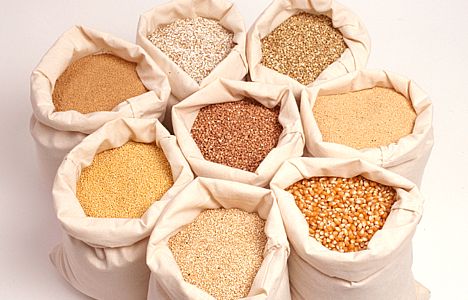
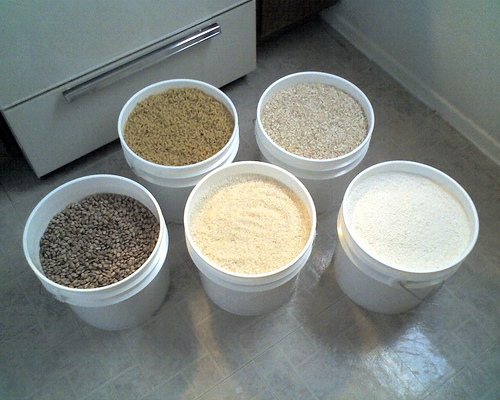
The first thing you will see on the usual food storage lists that are out there is the category of “grains”.  The standard rule of thumb you’ll hear most often is 300 pounds of grains per person, regardless of what their age is, for a year. I always plead that people NOT quibble about the ages of the persons in their family because it’s obviously likely to change… after all, kids get bigger with time, not smaller.  So since one doesn’t know when they will have to rely strictly on their year’s supply, it’s a good idea to prepare with the “worst case scenario” of needs of older kids in mind.

food storageNow grains constitutes all kinds of grains items such as flour, pasta, rice, muffin mixes, popcorn, spelt, quinoa, wheat, cereals, etc. (Notice we’re talking about WEIGHT here, so keep that in mind when you’re looking at that very big, but oh, so light box of Cheerios.)  Again, the most common rule of thumb amount for grains is 300 pounds. I’ve actually never said anything less than 350 pounds, but regardless, nearly all of you who are reading this will have that momentary shock to the system as you contemplate just how much grain that would mean  for a family of 4, let alone 7. Imagine how much that family on cable TV with 19 kids would need! Whooee!
Inevitably when I share the magic number of 350 pounds I will always hear someone declare “Oh, there’s no way that I consume that much grain in a year.” Well, either you live off of Hershey’s candy bars and plan on just leaving this life in a chocolate coma–perhaps not the worst that could happen *grin*—or you really don’t have a grasp on just how much a person actually consumes in a year. So think about this for a moment. Does your money ever last as long as you think it will? Surely you’ve experienced that “holy cow” moment in your life when you realized how fast that “extra $100” in your wallet disappeared. And surely you’ve at least seen plenty of folks who thought they had enough gas in their car to get them to their destination even though the needle was sitting on “empty.” And of course you’ve all experienced one of those days where you have no idea where all the time went, right?  Well then, isn’t it fair to say that when it comes to the topic of long-term food consumption there just might be a bit of perception error? And I’m about to show you just how far off that perception is in most homes–and I”m talking about homes in which people actually consider themselves to be mindful of these kinds of things.  Wait until I show you just how LITTLE that 300-350 pounds of grain in your food storage will provide you in the form of daily meals. (corrected)

The absolute minimum amounts of recommend food supplies for a year which provides you with “about a half of a small loaf of bread daily along with 3 small servings of beans” (corrected)are as follows:
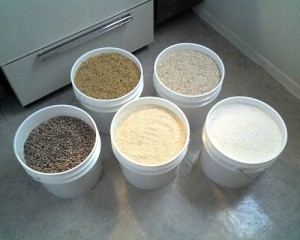
food storage300 pounds of grains per person (FYI, a pound of grain–depending on type–is between 2 1/4 – 2 1/2 cups)
75 pounds of legumes (pinto, black, red, lima, kidney, turtle, garbanzo, etc.)
75 pounds of milk (powdered, evaporated, etc.)
65 pounds of sweeteners (sugar, molasses, honey, etc.)
4 pounds of shortening*
2 gallons of oil *
2.5 pounds of leaving agents (yeast, baking soda, baking powder, etc.)
5 pounds of salt
45 gallons of water **

*This does NOT include other fats which are absolutely necessary for proper organ function such as buttercoconut oil, peanut butter, nuts, etc.

food storage**this is ONLY enough for an average of 3 daily consumable ration examples (corrected) as noted below and does NOT include the minimum of 2 quarts of watereach person should drink daily—minimum for proper body function, nor does it take into account any additional water needs such as laundry, bathing, sanitation, or any additional cooking.

That’s a LOT of Food Storage!!!

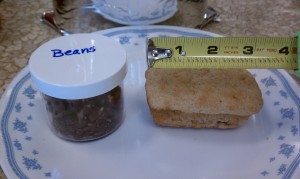
So, you see these massive amounts of food storage and think “Holy cow, that’s a LOT!” but I’m going to show you what JUST THESE items translate into a 3 times (corrected)DAILY RATION basis. Ready? Brace yourself…
food storage
Copyright 2012 Preparedness Pro All Rights Reserved

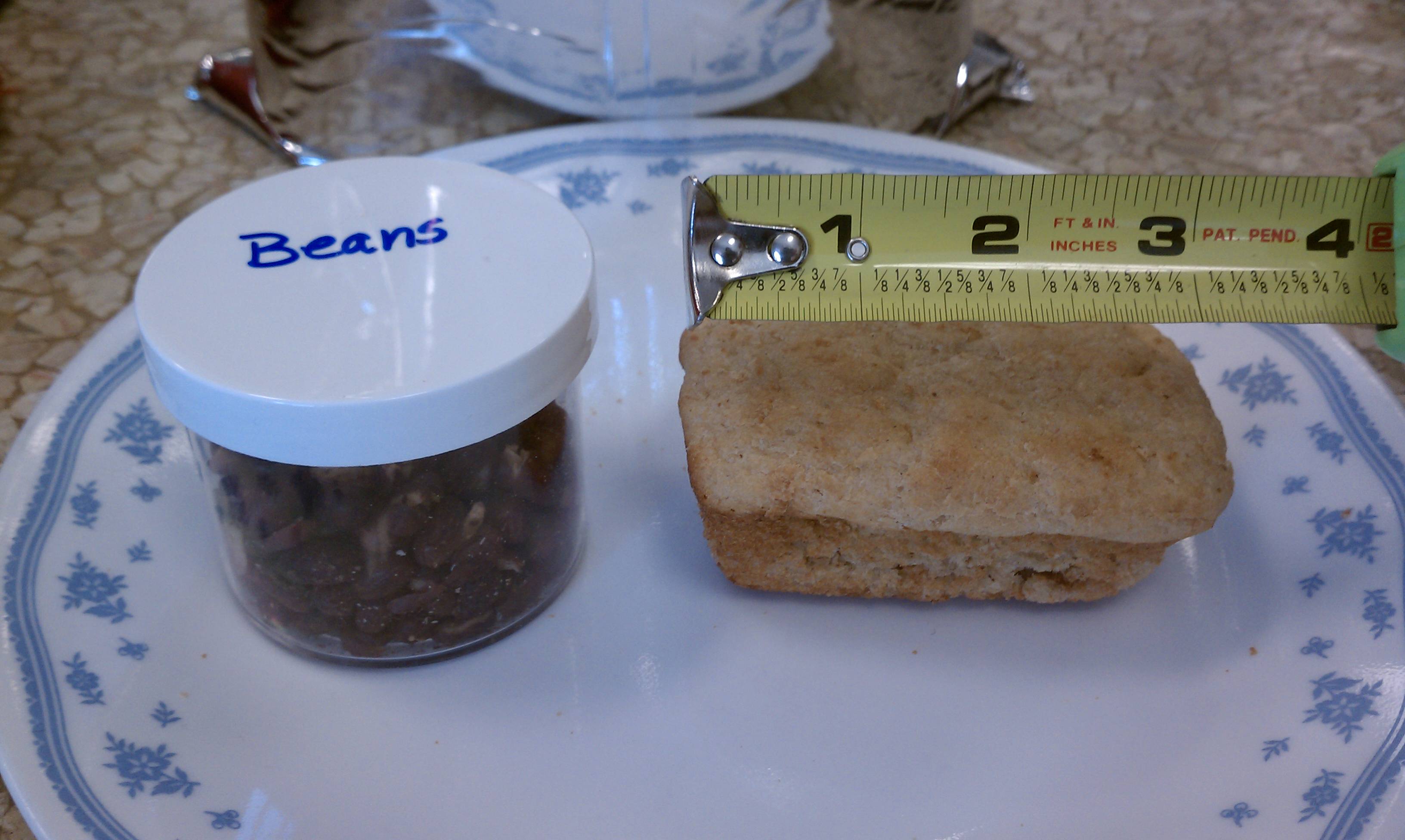
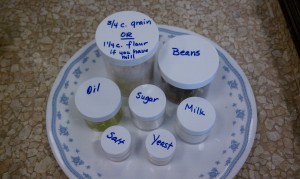
You see this pittance of an amount of beans and this tiny, UNdelectable  4 inch“loaf” of bread?  That’s what this “massive” amount of food translates into what you get to look forward to three times a day for one person.  Mmmmm…you’re just salivating like crazy right now aren’t you? Wow! That’s quite the feast there… Bet you can’t wait to dig into that, eh?

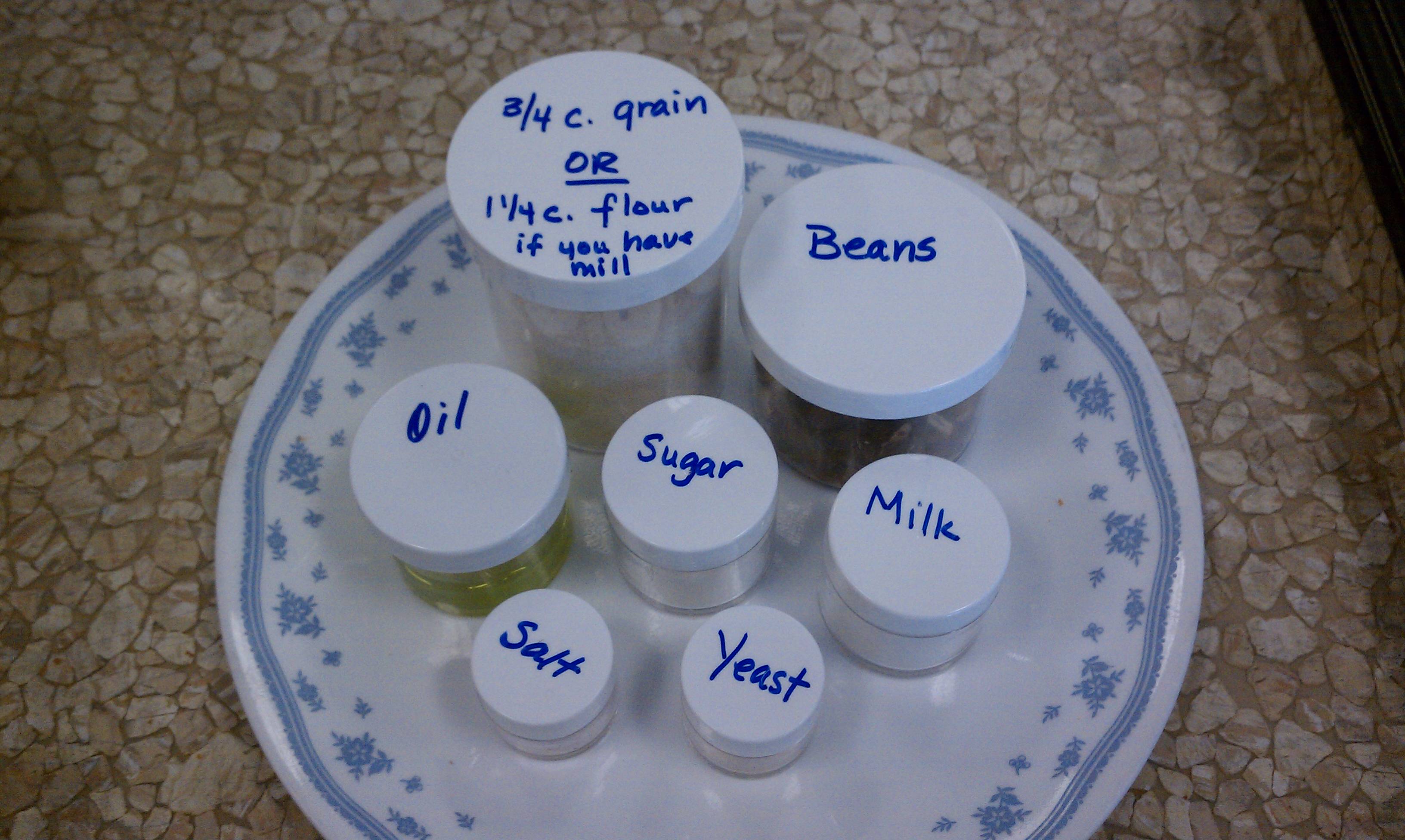
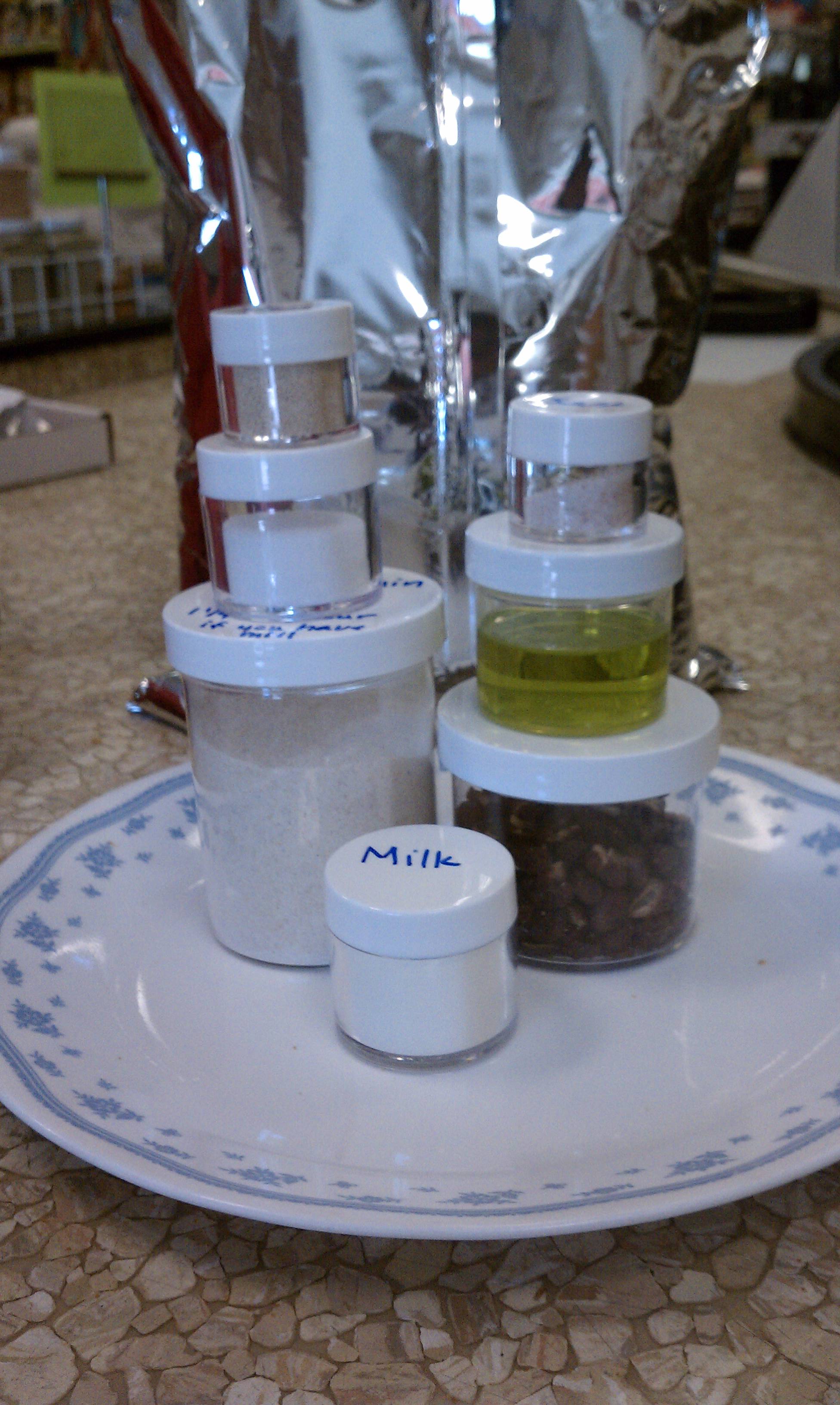
Here’s what was used to make this bountiful feast you see in the picture:
food storage
Copyright 2012 Preparedness Pro All Rights Reserved
¾ cup of grain (equals about 1 to 1 ¼ cup of flour IF and only IF you’re able to mill grind it)
1/3 cup of beans
2 Tablespoons of powdered milk
2 Tablespoons of oil (fat, lard, butter, etc.)
1 Tablespoon of sugar (in order to best activate the yeast)
2 ½ teaspoons of yeast
2 ½ teaspoons of salt
And approximately 24 ounces of water to cook the beans, make the bread, and for drinking water in order to ward off digestive ailments.

 What do YOU want your food storage to look like?

food storage
Copyright 2012 Preparedness Pro All Rights Reserved
Now, is there anything else missing…you know like fruits, vegetables, flavorings and spice, comfort foods, etc? How about some MEAT like chicken, ham, or beef? And where in the heck is the chocolate—medication of the sane?! And this isn’t exactly going to make my Blue Ribbon 100% Whole Wheat Bread either. Even if it did, I can tell you that my husband can happily polish off a whole loaf of a REAL sized loaf of bread in the first 24 hours after I’ve baked it, and I assure you, that’s not all he eats when I make bread…the irresistible, moist, light bread is consumed in addition to his regular meals. Seriously, can you even fathom serving your children or your elderly parents and grandparents nothing but this speck of food every day? This puts things in a little different perspective, I hope.

Perhaps now you understand why I cringe when people focus so much on traditional “food storage”? It’s simply NOT as abundant as people think it is, nor does it provide anywhere near enough calories to THRIVE. This kind of a minimalistic “preparedness” will not serve much more than to buy you a little bit more time before your most certain death—especially if you haven’t taken thought for the tools and skills needed to GROW and produce additional foods so that you’re not doomed for death by starvation on Day #375.

Consider this also…what about your INCREASED physical demands for nutrients because you’re having to do more food storagephysical labor that a true crisis scenario would demand? How about just lugging your bug-out bag for 5 miles every day? You think that this paltry amount of food will be enough to fuel your body and your spirit so that you can do that? How about the energy you’ll need to shovel a latrine, be alert and on guard, or washing laundry by hand? Can you also imagine just how grumpy people would be in an already stressful situation because this is all they have to eat?
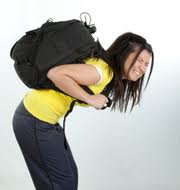
So, do you have enough food storage? Um…I’m thinking that at least double these minimal amounts of food is much more in line with the reality you’ll want to deal with in the event that life drastically changes for us.

(Special thanks to one and only Preparedness Diva, Lisa Barker, of Honeyville Grains for taking the time to put this visual together!)

February 4, 2012

Emergency Preparedness Kit

This is a post taken from the blog I am an Organizing Junkie. It is one of my new favorite places to learn new things. R

How to Put Together an Emergency Preparedness Kit


Before I talk about the emergency kit you need to have in your home, I want to talk about the emergency kit you should have in your car.  An emergency could happen while you are driving so it is smart to have a small tub in your trunk with a few emergency essentials.
This is what my emergency kit for my car looks like, it has a blanket, an extra pair of sneakers and socks (just in case I am wearing heels or sandals and need to vacate my car and walk), a flashlight, a power flare, and water.
Next let’s talk about emergency kits for your pet. This is my emergency kit for my pooch Harper, it contains a towel, food, water, and extra food dish, a leash, a toy, and her medicine (she has terrible allergies so Children’s Benadryl is a staple).  I keep her kit stored next to my emergency home kit, it is stored in a small bin so I could carry it with us if we had to evacuate.
Living in California I thought more people would have an emergency kit in their homes but I rarely see one.  When I ask my clients why they don’t have one they say they don’t worry about emergencies or they don’t know how to create one, or they have been meaning to set one up but they just keep forgetting.  How many of you have an extra supply of food, water, and emergency items in your homes?
This is what my kit looks like.  It is recommended you have supplies stored in air-tight tubs or on shelves in your garage or basement.  Mine are stored in a cabinet in our garage.  It holds all of our essentials and it is easy access to the kitchen if I need to replace or store extra items.  I also keep a duffel bag on top just in case I need to leave my house during an emergency.
Here are the items that should be in your kit, this list comes directly from FEMA.
  • Three-day supply of non-perishable food.
  • Three-day supply of water – one gallon of water per person, per day.
  • Portable, battery-powered radio or television and extra batteries.
  • Flashlight and extra batteries.
  • First aid kit and manual.
  • Sanitation and hygiene items (moist towelettes and toilet paper).
  • Matches and waterproof container.
  • Whistle.
  • Extra clothing.
  • Kitchen accessories and cooking utensils, including a can opener.
  • Photocopies of credit and identification cards.
  • Cash and coins.
  • Special needs items, such as prescription medications, eye glasses, contact lens solutions, and hearing aid batteries.
  • Items for infants, such as formula, diapers, bottles, and pacifiers.
  • Other items to meet your unique family needs.
Depending on your climate, this items might come in handy too…
  • Jacket or coat.
  • Long pants.
  • Long sleeve shirt.
  • Sturdy shoes.
  • Hat, mittens, and scarf.
  • Sleeping bag or warm blanket (per person)
I stock my kit with non-perishable food from Costco because it comes in bulk.  I chose items that we would eat normally like tuna, protein bars, peanut butter, fruit cups, canned chili, canned beans, and pasta.
There is also an extra pair of shoes, towels and blankets, moist wipes, and at least 3 days worth of water.  If you have a pool or live next to someone who has a pool think about investing in a high quality water filter.
Flashlights and a radio with extra batteries and a Powerflare, first aid kit, and toilet paper.  If you have never heard of Powerflare, go to their website, it is a much safer alternative to a flare.
Whenever I buy new blankets like these, I add the old ones to my emergency kit.
As important as it is to have an emergency kit, don’t forget to do these things to maintain your kit…
  • Keep canned foods in a dry place where the temperature is cool.
  • Store boxed food in tightly closed plastic or metal containers to protect from pests and to extend its shelf life.
  • Throw out any canned good that becomes swollen, dented, or corroded.
  • Use foods before they go bad, and replace them with fresh supplies.
  • Place new items at the back of the storage area and older ones in the front.
  • Change stored food and water supplies every six months. Be sure to write the date you store it on all containers.
  • Re-think your needs every year and update your kit as your family needs change.
  • Keep items in airtight plastic bags and put your entire disaster supplies kit in one or two easy-to-carry containers, such as an unused trashcan, camping backpack, or duffel bag.
Do you have an emergency preparedness kit ready to go?  If not I do hope you find the above tips helpful to put one together soon.


December 5, 2011

Reusable Canning Lids Order

We have an opportunity to order reusable canning lids with Friendswood 1st Ward. This is her email:


Attention Canners:
 
Just in time for Christmas!  I will be conducting a bulk order of reusable canning lids from Tattler
(Check out the website for more information. This is a really cool product!)
 
These lids are awesome!  If you have not heard of these, follow the link to learn more.  I have used them and they work well!  They are used just like metal lids, except you tighten them right after they are removed from the canner.  The lids consist of both a regular or wide mouth plastic lid and a regular or wide mouth rubber ring that fits around, respectively.  (You use your own metal rings.) 
 
These are a great preparedness item, and make great gifts!!  No more constantly buying and rebuying lids at the store.  Tattler reusable lids are very unique, they WORK, and they have a lifetime guarentee!  Stock up for yourself, family and friends. 
 
Check pricing here
 
Initially, they are more than metal lids, but can pay for themselves quickly.  And you will be getting the "insurance" that you can preserve your food without having to depend on new lids.  I have no idea how many orders we may receive, so I cannot say exactly what the cost per lid will be at this time, but you can get an idea at the link above.  I will be able to let you know your exact cost prior to order placement.  I must receive your payment with your order--you can email your order first and then send/drop off a check.  Shipping will be USPS Parcel Post to my address (orders cannot be shipped to more than one address), and the order will close 10 a.m. on DECEMBER 12.  I must make the order December 12th to insure they arrive before Christmas!
 
Let me know how many you would like in Regular and/or Wide Mouth.  Feel welcome to pass this offer to others--the more we receive the cheaper they will be!  I'll need your order and payment by December 12, 10 a.m. 
 
 :)  Thank you! 
 
Christen Wells
Friensdwood 1st Ward

Contact Christen to place your order. 

June 12, 2011

Surviving Disaster

It is time for us to be prepared (or preparing) for our next hurricane. This is an excellent website for us to use. It has Plans and Checklists, Evacuation Routes, Emergency Document Bag and much more.

May 19, 2011

72 Hour Kits

This is just a reminder to get your 72 Hour Kits together... AGAIN!

This is from Debbie R. website- Food Storage and Beyond. There is also a link on our sidebar under Emergency Preparedness.

What is a 72 Hour Kit-
http://foodstorageandbeyond.com/2010/07/emergency-preparedness-72-hour-kits/

What needs to be in a 72 Hour Kit-
http://foodstorageandbeyond.com/2010/07/emergency-preparedness-72-hour-kit-contents/

Updating your 72 Hour Kit-
http://foodstorageandbeyond.com/2010/10/emergency-preparedness-updating-72-hour-kits/

It is time to get prepared!

Hurricane Season is almost here!

Texas hurricane season officially begins June 1 and ends November 30.

Governor Rick Perry has proclaimed May 22 - May 29 as Hurricane Preparedness Week. 

The 624-mile Texas Gulf coastline is vulnerable to the devastating effects of a hurricane or tropical storm.  The City of Friendswood Office of Emergency Management urges all citizens of our community to participate in hurricane preparedness activities, and to pay close attention to watch and warning instructions.

Residents living in evacuation zones are encouraged to learn their evacuation routes in advance, and to also double-check emergency supply kits for themselves and their pets, as well as for persons with functional and access needs.

Citizens are encouraged to make plans for what they will do before and after a storm.  Hurricane preparedness information - including evacuation maps, supply checklists, and more is available at:  www.txdps.state.tx.us/dem/pages/weather_aware_hurricane.htm.


Be sure to check out this website from the state, especially the part for Post-Storm Preparation.


We had a great Emergency Preparedness class this week taught by Debbie R. Most of what she shared with us is on her blog Food Storage and Beyond. Check out all of the wonderful things that she has collected to share with us... AND, get prepared!